Contents
UNHCR counts 117.8 million people forcibly displaced at end-2025. A decade of data, the largest crises, the main hosts, and why a family plan B starts early.
According to the Global Trends report published by the UN Refugee Agency (UNHCR) in June 2026, 117.8 million people worldwide had been forced from their homes by conflict, violence, persecution or human rights violations at the end of 2025 – one in every 70 people on the planet. It was the first decline in a decade, driven mainly by returns to Afghanistan, Syria and Sudan, many of them under difficult conditions. For families far from any front line, the lesson in these numbers isn't fear. It's that a plan B is best prepared while everything is still calm.
Source: UNHCR, Global Trends: Forced Displacement in 2025 (June 2026)
There is no comparing a family fleeing shelling with an investor family weighing a second residence. Behind every figure in this piece are real people, and NAC reads this data with that in mind.
Even so, displacement data reveals things that tax tables and house-price indices can't: how long conflicts last, where people go, and how quickly the rules in receiving countries can change. This piece complements NAC's earlier article on the Global Peace Index 2026, so we won't repeat the peace scores here.
A Decade in Which Displacement Almost Doubled
At the end of 2015, UNHCR counted 65.3 million forcibly displaced people. The figure rose almost every year, passed 80 million in 2020, then jumped by about 19 million in 2022 alone – the year the armed conflict in Ukraine escalated. It peaked at 123.2 million at the end of 2024, almost double the level of a decade earlier.
View data table
| Item | Value |
|---|---|
| 2015 | 65.3 |
| 2016 | 65.6 |
| 2017 | 68.5 |
| 2018 | 70.8 |
| 2019 | 79.5 |
| 2020 | 82.4 |
| 2021 | 89.3 |
| 2022 | 108.4 |
| 2023 | 117.3 |
| 2024 | 123.2 |
| 2025 | 117.8 |
Source: UNHCR, Global Trends reports 2015–2025 (compiled via ecoi.net, Al-Monitor and the 2025 report)
2025 brought a fall – but not unqualified good news. According to the Global Trends 2025 report, the number of people still displaced dropped by 5.4 million, or 4%. The main reason was that 14.7 million people went home: 4.4 million refugees and 10.3 million internally displaced people. Refugee returns were the second-highest since UNHCR records began in 1965. Yet UNHCR stresses that many returned under adverse circumstances, to places with damaged infrastructure and continuing insecurity. For Afghans in particular, most returns were assessed as involuntary.
2026 has already brought new displacement. Since late February 2026, escalating hostilities in Iran and Lebanon have left about 3.2 million people temporarily displaced in Iran as of the end of March, and around 1 million displaced inside Lebanon. UNHCR estimates that by the end of April 2026, global forced displacement remained at roughly 117 to 118 million.
The Largest Crises Today
More than seven in ten refugees come from six countries: Afghanistan, South Sudan, Sudan, Syria, Ukraine and Venezuela. Sudan is now the world's largest displacement crisis. On top of 9.1 million people displaced inside the country, the number of Sudanese refugees abroad rose 35% in 2025 to 2.8 million.
Each figure tells a different story. Most of Venezuela's 6.4 million have been granted residence permits, and 97% remain in Latin America and the Caribbean. Ukrainian refugees edged up 2% to 5.2 million, around 95% of them in Europe. Syrian refugees fell 18% to 4.9 million after about 1.3 million people went home during the year. Afghan refugees fell 36% to 3.7 million.
Most refugees live in a neighbouring country, and seven in ten have been away from home for five years or more.
Most People Stay Close to Home
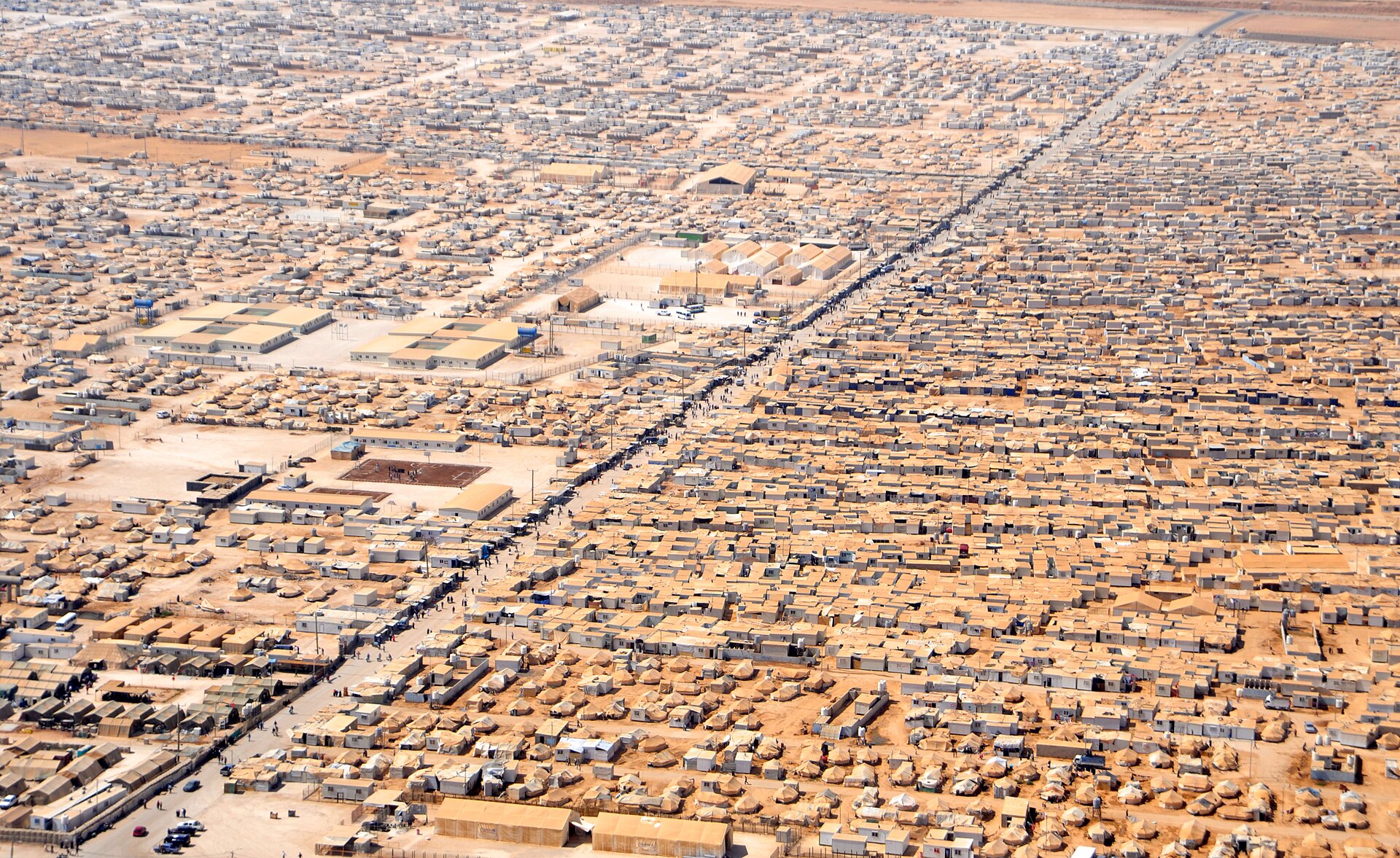
People forced to flee rarely go far. According to UNHCR, 65% of refugees live in a country bordering their own, and 68% are hosted by low- and middle-income countries. Colombia, Germany and Türkiye host the most, more than 2 million each.
Exile lasts longer than most people imagine. Almost 70% of refugees are in protracted situations, meaning they have been away for five years or more with no durable solution in sight. In Eastern and Southern Africa, the median time a person spends as a refugee or asylum-seeker is just under 16 years – close to a generation. Children make up 39% of refugees, against 29% of the world's population.
Humanitarian routes are narrowing too. In 2025, arrivals through resettlement to a third country fell by more than half to 81,800, largely because the US suspended most refugee admissions from January 2025.
How Conflict Rewrote the Rules of Investment Migration
War doesn't only create refugees. It also pushes governments to change how they grant residence to investors – sometimes within days.
| Date | Change | Note |
|---|---|---|
| 17 Feb 2022 | UK closes the Tier 1 Investor visa to all new applicants | Security concerns cited, including illegitimately acquired wealth |
| Mar 2022 | European Commission recommends suspending investor residence permits for all Russian and Belarusian nationals | Also urges repeal of investor citizenship schemes |
| From 2022 | EU grants temporary protection to people fleeing Ukraine | 4.41 million beneficiaries on 30 June 2026 |
| Jul 2026 | EU extends temporary protection to 4 March 2028 | New condition for newly arriving men of military-service age |
The rules changed by nationality, not by individual. As eucrim reported, the Commission's 2022 recommendation called for investor residence permits to be suspended for all Russian and Belarusian nationals, not only those under sanctions. Weeks earlier, the UK government had shut its Tier 1 investor route with immediate effect. Plans that relied on a single route closed with one announcement.
A plan B is best prepared while everything is calm, not once the doors start closing.
Temporary protection is a lifeline, not a plan. As Eunews reported from Eurostat data, 4.41 million people who fled Ukraine held temporary protection in the EU on 30 June 2026, most of them in Germany (1,286,230), Poland (961,170) and Czechia (390,810). The status is renewed a year at a time. Ukraine's Ministry of Social Policy reported that the EU Council has adopted the latest extension, to 4 March 2028, with a new condition attached. Millions of families are still living from one extension to the next.
Reading the Numbers Properly
UNHCR's figures are rounded and provisional, and may be revised. Data on internal displacement comes from the Internal Displacement Monitoring Centre (IDMC), which counts 68.7 million people, while UNHCR itself reports 64.2 million conflict-affected internally displaced people. Most of Venezuela's total falls under "other people in need of international protection" and already holds residence permits – a very different situation from life in a camp.
Return figures need care too. In large return movements it is extremely hard to tell voluntary returns from deportations. So the fall in 2025 doesn't necessarily mean the world became more peaceful.
A practical strategy for Vietnamese investors
Prepare while life is normal. 2022 showed that policy can change by nationality within weeks. Residence rights are most valuable when a family already holds them, with the paperwork done and the asset properly vetted.
Split your options across two regions. European residence – through something like Kifisia Suites in Athens – paired with an option in the Americas, such as Santa Maria in Panama City, keeps a family from depending on any one geopolitical setting.
Favour stable law and a clear track record. An EU member state such as Cyprus, with projects like Limassol Blu Marine, operates inside the bloc's common legal framework. That framework can still change, but it changes through public procedure.
Read the signals, not the headlines. Residence decisions should rest on years of data, not a single news cycle. NAC's piece on where Vietnamese families should base a second home in a divided world goes deeper into the question.
Frequently asked questions
How many people are forcibly displaced worldwide?
UNHCR counted 117.8 million at the end of 2025, down from a record 123.2 million in 2024. Its estimate for the end of April 2026 was still around 117 to 118 million.
Which countries host the most refugees?
Colombia (2.8 million), Germany (2.7 million) and Türkiye (2.4 million), followed by Uganda, Iran, Chad and Pakistan.
How long does EU temporary protection for people fleeing Ukraine last?
The EU Council has adopted an extension to 4 March 2028. Newly arriving men of military-service age must meet an additional condition.
NAC strategic insight
Nobody builds a plan B hoping for the worst. UNHCR's numbers point to something simple: when a crisis comes, people who already hold documents, a place to go and assets in a stable legal system have far more choices. Those things take months to put in place, and preparing in calm times is always easier than preparing in a hurry.
NAC helps Vietnamese families build a second option calmly: comparing residence programmes, vetting the assets attached to them and fitting it all into the family's long-term plan. If you'd like to start, book a consultation with NAC.
Sources
- UNHCR — Global Trends: Forced Displacement in 2025 (2026)
- UNRIC — Forced displacement falls but remains alarmingly high (2026)
- eucrim — Commission's recommendation on investor schemes following the Russian invasion of Ukraine (2022)
- GOV.UK — Tier 1 Investor visa route closes over security concerns (2022)
- Eunews — Ukraine, EU temporary protection up by 0.6 per cent in June (2026)